She Bought a French Dictionary and Changed American History: The Improbable Sky of Bessie Coleman
She Bought a French Dictionary and Changed American History: The Improbable Sky of Bessie Coleman
In 1919, Bessie Coleman walked into the office of Robert Abbott, the founder of the Chicago Defender and one of the most influential Black newspaper editors in the country. She told him she wanted to fly airplanes. Abbott didn't laugh. He told her to learn French.
That single conversation — between a woman who'd picked cotton as a child and a man who understood that American doors weren't going to open — set in motion one of the most unlikely stories in aviation history.
The Girl From the Cotton Fields
Bessie Coleman was born in 1892 in Atlanta, Texas, the tenth of thirteen children. Her family were sharecroppers, and Bessie spent her early years doing what sharecroppers' children did: working the land, walking miles to a one-room schoolhouse, and watching the world happen to other people.
She was sharp, though. Relentlessly so. She taught herself to read using the Bible and whatever books she could get her hands on, and she had a head for numbers sharp enough that she was trusted to keep the family's cotton-weighing accounts — no small thing when you're a Black child in Jim Crow Texas and the people holding the scales have every incentive to cheat you.
At 23, she moved to Chicago to live with her brothers and found work as a manicurist in a barbershop on the South Side. It was there, listening to soldiers returning from World War I swap stories about flying over the French countryside, that something clicked. She decided she was going to be a pilot.
Every Door in America
This was 1918. The Wright Brothers had flown at Kitty Hawk just fifteen years earlier. Aviation was still wild, dangerous, and deeply glamorous — and the establishments that controlled it were white and almost entirely male. Bessie applied to flight schools across the United States. Every single one rejected her. Some didn't bother explaining why. The combination of her race and her gender was, apparently, reason enough.
Another person might have filed that dream away and moved on. Bessie Coleman was not another person.
Abbott's advice — learn French, go to France — wasn't a consolation prize. It was a genuine strategy. French aviation schools had no particular interest in enforcing American racial hierarchies. France had its own complicated history, but in the cockpit, what mattered was whether you could fly. Bessie took French lessons at night after her shifts at the barbershop. She saved money. She applied to the Fédération Aéronautique Internationale's certified schools in France, and she got in.
Paris, 1920
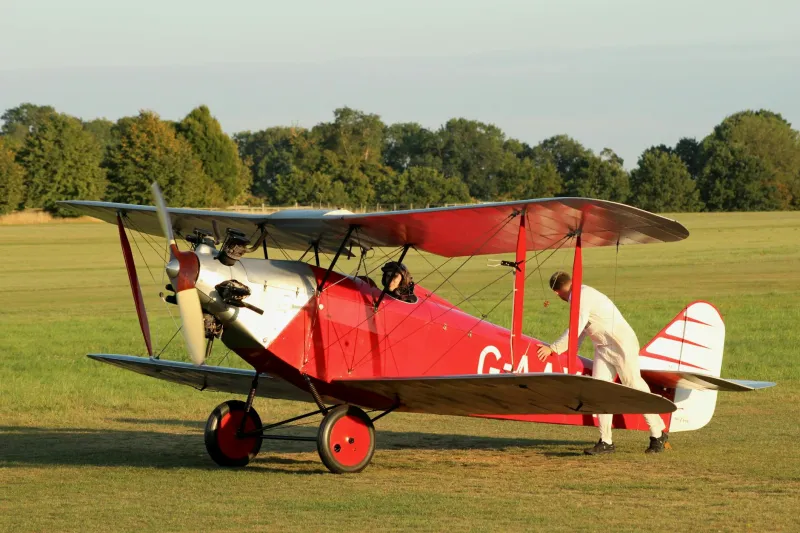
She arrived in France in November 1920 and enrolled at the École d'Aviation des Frères Caudron in Le Crotoy — a coastal town in northern France where the wind off the English Channel apparently made for excellent, if punishing, training conditions. The planes she flew were Nieuport 82s, biplanes with open cockpits and a reputation for being unforgiving. Students died in training. Bessie watched a fellow student die in a crash during her time there and kept going.
On June 15, 1921, Bessie Coleman received her international pilot's license from the Fédération Aéronautique Internationale. She was the first African American — and the first Native American, through her Cherokee heritage on her father's side — to earn one. She was 29 years old.
She came home to a country that had tried to stop her from leaving.
The Barnstormer
Back in the United States, Bessie Coleman became a barnstormer — performing aerial stunts at air shows across the country. She was good at it. She looped, dived, and figure-eighted her way into headlines, and she did it with a showman's instinct for spectacle that made her a genuine draw. The press called her "Brave Bessie." She called herself a pilot.
But she had a condition. She refused to perform at venues that didn't allow Black spectators, and she refused to speak at segregated events. In 1920s America, that was not a small stance to take. She walked away from bookings that would have paid real money because the terms were wrong. She understood that the story she was telling — with her body, in the air — was bigger than any single performance fee.
Her ambition didn't stop at barnstorming. She wanted to open a flight school for Black Americans. She was actively fundraising for it when, in April 1926, a mechanical failure sent her plane into a fatal dive during a rehearsal flight in Jacksonville, Florida. She was 34.
What She Left Behind
Bessie Coleman never got to open that school. But the pilots she inspired did. William J. Powell founded the Bessie Coleman Aero Club in Los Angeles in 1929, explicitly in her honor. The Tuskegee Airmen — the legendary all-Black fighter pilot unit of World War II — flew in a sky that Bessie Coleman had helped crack open. When the first group of Black female aviators organized in 1977, they named themselves the Bessie Coleman Aviators.
Every year, Black pilots fly over her grave in Chicago and drop flowers.
The crooked path Bessie Coleman walked — from cotton fields to a Chicago barbershop to a French airfield to the barnstorming circuit — wasn't a detour. It was the only route available to someone the country had decided shouldn't exist in the spaces she wanted to occupy. She took every wrong door and turned it into a runway.
She just had to go to France first.