Rejected by Everyone: Five Americans Told 'No' So Many Times They Built Their Own Yes
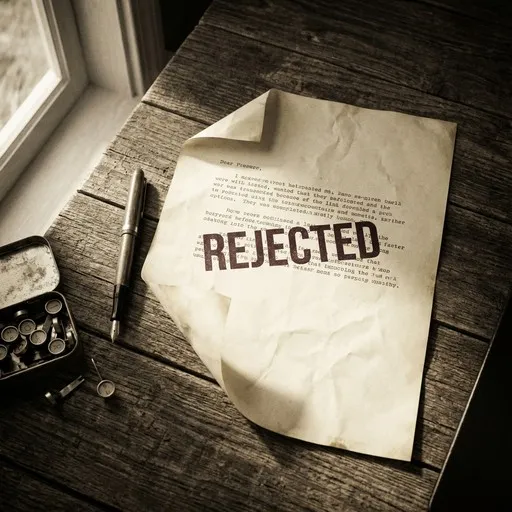
Photo: stack of rejection letters on wooden desk dramatic lighting, via images.stockcake.com
Rejection letters have a certain voice. Formal, regretful, final. "We regret to inform you." "The committee has decided." "We encourage you to pursue other paths."
These five Americans got that voice aimed at them repeatedly — and treated it less like a door closing and more like a dare. Their stories all end the same way: with the very institutions that rejected them eventually asking for their help.
The Lawyer Who Couldn't Pass the Bar — Then Changed Who Gets to Practice
She failed the bar exam three times. Three. In an era when the exam was still heavily weighted toward rote memorization and, in her state, administered with little accommodation for dyslexia she'd hidden her whole life, she kept coming up short while classmates who'd scored below her in law school sailed through.
She worked as a paralegal for years — doing lawyer work at a fraction of the pay because she couldn't get licensed. Then she turned her fight outward: advocacy, testimony, a landmark push that forced her state's bar examiners to adopt testing accommodations. She passed on her fourth attempt. Today, thousands of dyslexic law students take the exam under rules she fought into existence, and the bar association that once rejected her invites her to speak to every incoming class of examiners.
The Doctor Rejected by Every Residency — Who Rebuilt the Pipeline
He applied to thirty-two residency programs. Got thirty-two no's — a file flagged by an administrative error he couldn't get removed, a rejection cascade that no single program bothered to question.
Instead of quitting medicine, he built a workaround: a free clinic staffed by other unmatchable graduates, treating a rural county with no physicians at all. The clinic's outcomes got noticed. The error in his file got noticed too. Within a decade, the same hospital network that passed on him was funding his clinic as a residency training site — and he was the one interviewing the applicants. He says he reads every file twice.
The Astronaut Candidate Cut in Round One
NASA's selection process rejected her before the interviews even started — a paperwork technicality, a degree counted in the wrong category. The rejection letter is framed in her office now, which tells you everything.
She spent the next ten years in aerospace engineering, working on the exact systems she'd been told she wasn't qualified to operate. When she applied again, NASA didn't just accept her — the mission specialist who later trained on the hardware she helped design was, in a sense, learning from her. She flew twice. The framed letter hangs next to the mission patch.
The Chef Turned Away From Every Culinary School
He got one rejection after another from the country's most prestigious cooking programs — no formal training, no connections, a resume that read "line cook, short-order cook, dish washer."
So he learned the crooked way: a failing roadside diner he bought for almost nothing, a menu he reinvented nightly, a philosophy of cooking born from scarcity instead of schooling. Critics found him eventually. Then the culinary schools did — and today the same institutions that rejected him run externship programs in his restaurants. He still says the diner taught him what no school could: how to cook when it matters tonight.
The TV Writer Whose Script Got Binned
Her spec script was rejected by every show on the air — one assistant famously told her agent the writing was "not ready for a room." She spent five years writing anyway, publishing sharp cultural criticism that made network executives look like they'd misread the culture. When a struggling series needed a voice that understood its audience, the same network came calling.
She ran the show within three seasons. The assistant who wrote the rejection? She later hired her — and says, without irony, that it was the best decision she ever made.
The Pattern
Look at these five side by side and the lesson isn't "persevere" — it's something sharper. Each of them was rejected for the same reason they later succeeded: they didn't fit the template. The bar exam couldn't see past dyslexia. The residency algorithm couldn't see past an error. NASA couldn't see past a form.
The institutions weren't evil. They were just blind in predictable places. And the people they turned away — the ones forced to build their own path — ended up seeing exactly what the gatekeepers couldn't.