From Federal Inmate to Five-Star Kitchen: How Jeff Henderson Cooked His Way Out of the Worst Chapter of His Life
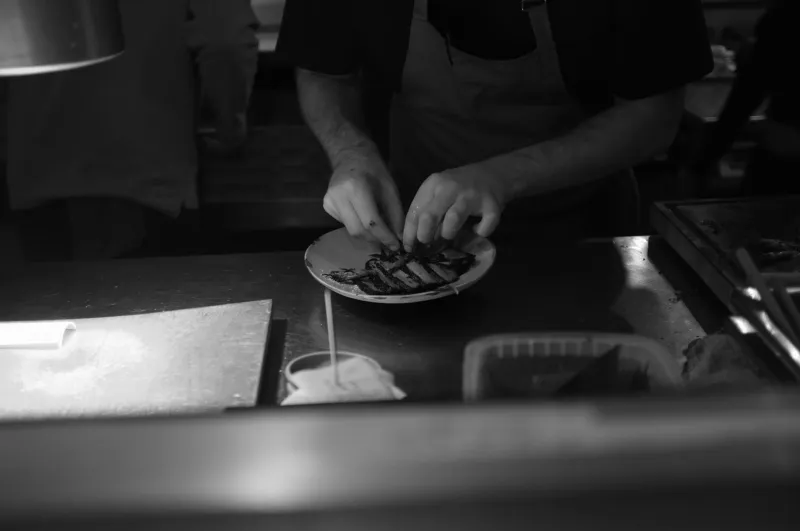
From Federal Inmate to Five-Star Kitchen: How Jeff Henderson Cooked His Way Out of the Worst Chapter of His Life
There's a version of Jeff Henderson's story that gets told in inspirational montages and motivational keynotes, and it goes like this: man hits bottom, finds passion, rises to the top. Clean arc. Satisfying resolution. The kind of story that gets a standing ovation at corporate retreats.
The real version is messier, slower, and considerably more interesting.
The Life Before
Jeff Henderson grew up in South Central Los Angeles and later San Diego in the 1970s and '80s — a world shaped by poverty, street economics, and the particular gravitational pull that the crack cocaine trade exerted on young men who saw no obvious alternative path to anything. By his early twenties, Henderson was running a drug operation that, by his own account, was generating serious money. He was also, by his own account, fully aware that it wasn't going to end well.
In 1988, federal agents arrested him. He was eventually convicted on drug trafficking charges and sentenced to nearly 20 years — later reduced, and he served close to a decade. He entered the federal prison system at 24 years old.
This is where most versions of the story skip ahead. But the middle part is where everything actually happened.
The Kitchen as Classroom
Federal prisons assign inmates to work details. Henderson ended up in the kitchen. By his own description, he was not immediately transformed. He wasn't struck by a culinary calling the moment he picked up a ladle. What happened was more gradual — and more human.
He started paying attention. The kitchen had structure and logic. There were techniques that, once learned, produced consistent results. There was a cause-and-effect relationship between effort and outcome that the world Henderson had grown up in didn't always offer. He began to find that satisfying in a way he hadn't expected.
He also started stealing cookbooks from the prison library. Not literally stealing — checking them out and copying passages by hand, studying them the way other inmates studied law books looking for appeal angles. He was building a culinary education from the ground up, in a federal facility, with institutional kitchen equipment and whatever ingredients the system provided.
Then he met a mentor.
The Man Who Saw Something
The details of Henderson's prison mentorship vary depending on the interview or account you're reading, but the shape of it is consistent: a more experienced kitchen worker — in some accounts a fellow inmate, in others a civilian staff member — recognized that Henderson's interest was genuine and started teaching him with real intention. Not just technique, but philosophy. The idea that cooking was a craft with standards. That there was a difference between feeding people and feeding people well.
For Henderson, this was genuinely new information. He'd grown up in an environment where the idea of a professional culinary career was not a thing that existed in anyone's imagination. The mentor didn't just teach him to cook. He expanded what Henderson thought was possible for someone like him.
This is the part of the story that tends to get compressed in the inspirational version, and it's the part that matters most. Reinvention doesn't happen in a vacuum. It almost always requires someone who decides, for whatever reason, to invest in a person that the surrounding system has written off.
The Exit and the Climb
Henderson was released in the mid-1990s and did what most people with a federal drug conviction discover: the doors were not open. He applied to restaurants and got turned away. His record was a wall. He took whatever kitchen work he could find — entry-level, unglamorous, sometimes humiliating for a man who knew he could outwork and outthink the people running the room.
He did it anyway. He moved through kitchens in San Diego and Las Vegas, taking every opportunity to learn, to prove himself, to build a reputation that could eventually outweigh a background check. He was obsessive about it. Colleagues who worked with him during this period describe someone who treated every shift like an audition and every dish like a statement.
In 2001, Jeff Henderson was named executive chef at Café Bellagio in Las Vegas. In 2007, he became the executive chef at Caesars Palace — the first African American to hold that position at one of the most storied hotel properties in the country.
He was 43 years old.
What the Story Is Actually About
Henderson has written a memoir, Cooked, appeared on Food Network, and spent years speaking publicly about his path. He's been careful, in most of those conversations, not to let the story become too tidy. He doesn't frame his prison years as secretly a gift. He doesn't suggest that the system worked because it worked for him.
What he does argue — and it's worth sitting with — is that the decision to see a person as permanently defined by their worst chapter is a choice. It's a choice made by employers, by parole boards, by neighbors, and sometimes by the people themselves. He made a different choice. So did the mentor who saw something in a young man mopping floors and chopping vegetables in a federal kitchen.
The culinary world Henderson entered was, and largely remains, a world of long hours, low early pay, high pressure, and ferocious competition. He had no culinary school pedigree, no family connections in the industry, and a federal conviction that followed him through every job application. The fact that he made it to the top of that world isn't just an inspiring story about one man.
It's a question the rest of us have to answer: how many Jeff Hendersons never got the kitchen assignment, never met the mentor, never found the crooked path out? And what did we lose because of it?