The Memory Palace That Toppled Jim Crow: How a Small-Town Librarian's Mind Became the Civil Rights Movement's Secret Weapon
The Room Nobody Noticed
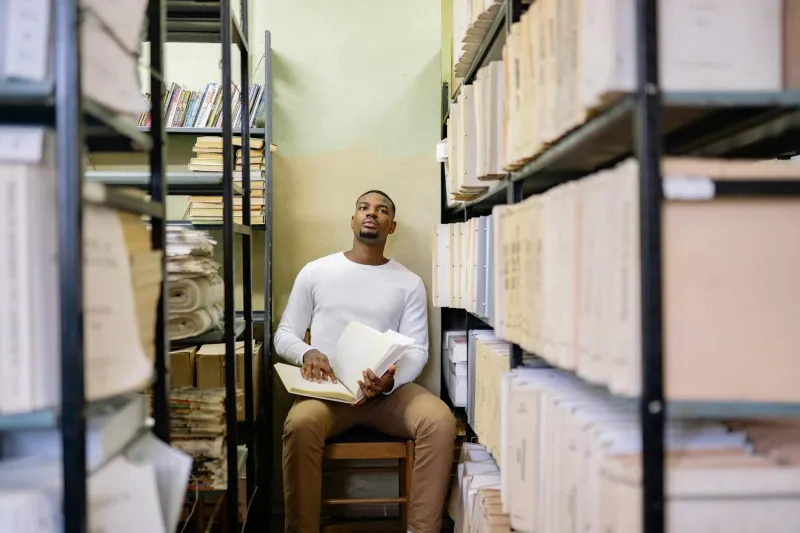
In 1952, if you walked into the Montgomery Public Library's "colored section," you'd find what looked like organized chaos. Books stacked in precarious towers, manila folders bursting with newspaper clippings, and index cards covered in Braille scattered across every available surface. At the center of it all sat Hazel Gladney Johnson, a 34-year-old woman who had lost her sight to glaucoma at age twelve but had somehow turned a converted storage closet into the most dangerous room in Alabama.
Dangerous, that is, if you were in the business of keeping Black Americans from their constitutional rights.
Johnson didn't look like a revolutionary. She wore sensible dresses, kept her hair in a neat bun, and spoke in the measured tones of a woman raised to navigate the treacherous waters of the Jim Crow South. But behind her thick glasses and quiet demeanor was a mind that had become something unprecedented: a human legal database that could recall obscure precedents, forgotten statutes, and overlooked constitutional arguments with photographic precision.
The Accident That Built a Weapon
Johnson never planned to become the civil rights movement's secret librarian. Born in rural Alabama in 1918, she had dreamed of becoming a teacher until glaucoma stole her vision during her senior year of high school. In an era when disabled Americans—especially disabled Black Americans—were expected to disappear into the margins of society, Johnson's family scraped together enough money to send her to the Alabama Institute for the Deaf and Blind.
It was there that she discovered her superpower: an ability to absorb and retain information that bordered on the supernatural. While other students struggled with Braille, Johnson devoured entire law books, committing not just the text but the precise legal citations to memory. Her instructors were baffled. Her classmates called her "the walking library."
After graduation, Johnson landed a job at the Montgomery Public Library's segregated branch—a position that paid $18 a week and came with a workspace that doubled as a broom closet. Library administrators figured they were doing their civic duty by hiring a disabled Black woman for what they assumed would be clerical busy work.
They had no idea they had just handed the keys to their legal archives to someone who would use them to tear down the very system that employed her.
Building the Underground Railroad of Information
Johnson's transformation from librarian to legal strategist began with a simple request. In 1954, a young lawyer named Fred Gray walked into her library looking for precedents related to public transportation segregation. He was working on a case involving a seamstress named Rosa Parks, and he needed ammunition.
What happened next would become the template for one of the most sophisticated information networks in American history. Johnson didn't just find the cases Gray needed—she found cases he didn't know existed. Obscure rulings from Reconstruction-era courts. Forgotten constitutional arguments from the 1890s. Interstate commerce precedents that had been gathering dust for decades.
Within hours, Gray had a legal strategy that would help launch the Montgomery Bus Boycott.
Word spread quickly through the tight network of civil rights attorneys across the South. Soon, Johnson's converted storage room became an unofficial research headquarters for lawyers like Thurgood Marshall, Constance Baker Motley, and Charles Hamilton Houston. They would arrive with specific questions and leave with comprehensive legal briefs that Johnson had dictated from memory, complete with precise citations and strategic recommendations.
The Woman Behind Brown v. Board
By 1955, Johnson's influence extended far beyond Montgomery. When the NAACP Legal Defense Fund was preparing its arguments for Brown v. Board of Education, they sent researchers to libraries across the country. But increasingly, those researchers found themselves making pilgrimages to a small room in Alabama to consult with a woman who had become a living, breathing legal encyclopedia.
Johnson's contribution to Brown was both profound and invisible. She identified dozens of precedents that established education as a fundamental right, found constitutional arguments that previous legal teams had overlooked, and helped craft the strategic framework that would convince the Supreme Court to overturn Plessy v. Ferguson.
Yet when the decision was announced in May 1954, Johnson's name appeared nowhere in the historical record. She was a Black woman with a disability working in a segregated library in Alabama. The legal establishment wasn't interested in acknowledging that some of their most powerful arguments had originated in a converted broom closet.
The Price of Being Invisible
Johnson's anonymity was both her protection and her curse. While other civil rights leaders faced constant threats, harassment, and violence, she remained safely hidden in plain sight. Local authorities knew her as the quiet librarian who kept to herself. They had no idea she was systematically dismantling the legal foundations of segregation from her corner of their own public library.
But invisibility came with costs. Johnson worked without recognition, without adequate compensation, and without the support networks that sustained other movement leaders. She funded much of her research from her own meager salary, often skipping meals to buy law books and legal journals that she would memorize and then share with attorneys across the South.
By the early 1960s, as the civil rights movement gained momentum and media attention, Johnson found herself increasingly isolated. The movement had outgrown her small library, and younger activists were building new networks that relied on different kinds of expertise. The woman who had helped architect the legal strategy that toppled Jim Crow was slowly being forgotten by the very movement she had helped create.
The Legacy Hidden in Plain Sight
Hazel Gladney Johnson died in 1987, three years after retiring from the Montgomery Public Library. Her obituary ran four lines in the local newspaper and mentioned only her decades of service as a librarian. There was no reference to her role in the civil rights movement, no acknowledgment of the legal briefs that had originated in her memory, no recognition of the countless hours she had spent building the intellectual ammunition that helped dismantle American apartheid.
But Johnson's true legacy lives on in every civil rights victory that followed Brown v. Board, in every constitutional argument that built on the precedents she unearthed, in every legal strategy that traced its roots back to a converted storage room in Montgomery, Alabama.
Today, when law students study the great cases of the civil rights era, they're learning from arguments that a blind librarian crafted from memory in a segregated library more than seventy years ago. They just don't know it.
Sometimes the most powerful revolutions happen in the quietest rooms, led by the most unlikely heroes. Hazel Gladney Johnson proved that you don't need to march in the streets to change the world. Sometimes all you need is a perfect memory, access to the right books, and the courage to use what you know to tear down the walls that others insist can never fall.