She Was the Chemist Nobody Promoted. Then a Routine Test at 2 A.M. Changed Cancer Treatment.
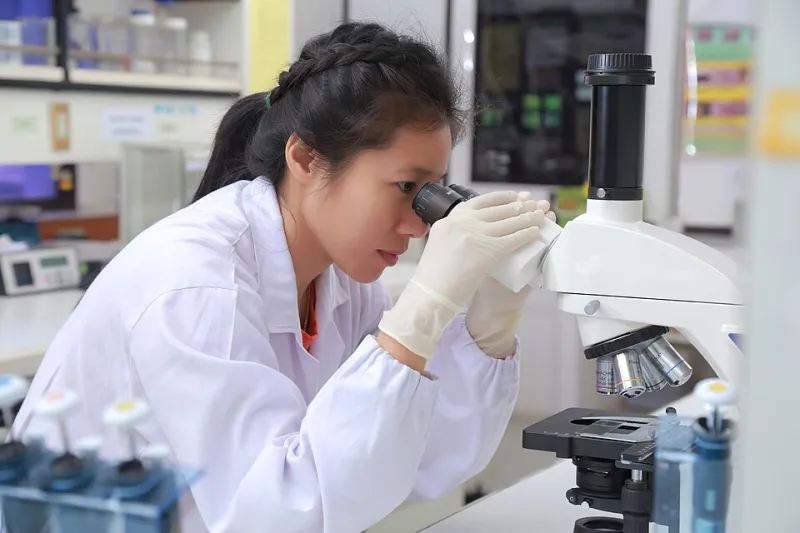
Photo: Yakuzakorat, CC BY 4.0, via Wikimedia Commons
The lab at St. Vincent Medical Research smelled like ethanol and burnt coffee, and at two in the morning it belonged almost entirely to Ruth Delgado.
That wasn't a privilege. It was a verdict. The day shift — the PhDs, the grant winners, the people whose names appeared on the publications — worked nine to five. Ruth ran the overnight samples, the routine toxicity screens nobody wanted to babysit. She'd been doing it for seven years.
She had also failed her doctoral qualifying exams. Twice.
The Profile She Never Matched
Ruth came to science the crooked way. First-generation college student, community college chemistry courses taken at night while she worked days as a pharmacy tech. When she finally got into a doctoral program, she was older than most of her cohort, slower to absorb the math, and — by her own admission — "terrified of looking dumb, which makes you look dumb."
Her examiners weren't cruel. They were just efficient. Her written answers were solid; her oral defense was a disaster. The second failure came with a polite suggestion that she "consider whether the research track was the right fit."
So she took the fit she could get: staff scientist, night rotation, contract lab attached to a hospital oncology wing. Her job was to run standardized assays on candidate compounds and flag anything toxic. Flag it, log it, move on. The protocol had no column for curiosity.
The Result That Wouldn't Log Cleanly
One Tuesday night, a batch of routine screens came back with a pattern Ruth had never seen. A compound being tested for something unrelated — an anti-inflammatory candidate, long since deprioritized — was behaving strangely in one cell line. Not toxic, exactly. Something else. The cells weren't dying the way dying cells were supposed to die.
The manual said: record anomaly, note possible contamination, re-run.
She re-ran it. Same result.
Here's where the story bends. A researcher trained to expect a specific answer would likely have seen noise. Ruth — who had spent years outside the room where assumptions get made — didn't know what she was supposed to ignore. She started pulling papers on her breaks. She emailed a professor she'd had eight years earlier. She stayed past her shift, unpaid, because the overnight manager didn't care as long as the samples were done.
"I think everyone else had already decided what that compound was," she told a colleague later. "I didn't have the sense to be sure."
Seven Years of Being Almost Right
What followed was not a movie montage. It was seven years of rejected grant applications — reviewers noted she "lacked the conventional research pedigree" — of department heads who wanted the finding but not her name on it, of a paper that sat under review for fourteen months. Her co-author slot on the first publication was third. She'd done nearly all the bench work.
But the mechanism held up. The compound, it turned out, disrupted a repair pathway that certain tumor cells depend on — a vulnerability the field had largely written off as a dead end. The reason everyone had written it off was a methodological assumption baked into the standard assay. The standard assay Ruth had run, unthinkingly but also unblinded by expectation, thousands of times.
Today, drugs built on that pathway are in late-stage trials for two hard-to-treat cancers. Patients are enrolled. Families have gotten extra years they didn't expect.
What the Exams Missed
Ruth Delgado finally defended a doctorate at fifty-one. She says the degree mattered less than the night she decided her anomalous result was worth her own time, since nobody else was going to give her any.
She still teaches, mostly to students who took the crooked path — the community college transfers, the night-shift techs, the people the qualifying exam didn't fit. Her advice is short: "The most dangerous person in a lab is the one who's stopped being surprised. Stay surprised."
The field nearly missed her because she failed the test of fitting in. It turned out the test was measuring the wrong thing.