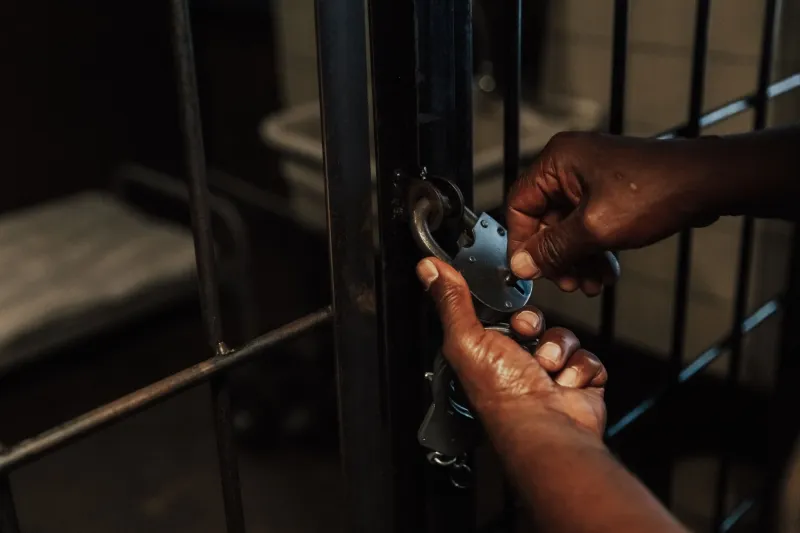
He Did the Time. Then He Came Back and Tore the Building Down.

The first thing Damon Himelfarb noticed when he walked into the Rikers Island intake facility in 2003 was the lighting. Fluorescent, relentless, the kind that flattens everything into the same gray sameness regardless of the hour. There were no windows in the processing room. There was no way to tell if it was morning or midnight. That disorientation, he would later come to understand, was not accidental.
He would spend the next nine years paying attention to things like that — to the ways that prisons were built not just to contain people, but to disorient them, to strip away the ordinary rhythms and spatial cues that human beings use to feel like themselves. He had a lot of time to pay attention. He used most of it.
What You Learn When You Can't Leave
Himelfarb had no background in architecture or public policy before his incarceration. He'd been a contractor in the Bronx — residential renovations, mostly, with some commercial work on the side. He knew how buildings were put together, but he'd never thought much about why they were put together the way they were. Prison changed that.
In the early years, the attention was mostly instinctive — a tradesman's habit of noticing how spaces worked, or didn't. The sightlines that left prisoners perpetually visible to guards but gave guards no reciprocal exposure. The absence of any communal space that wasn't also a surveillance zone. The way the physical architecture of a cellblock communicated, wordlessly and constantly, a single message: you are not trusted, you are not safe, you are not a person who deserves privacy or dignity or peace.
By his fourth year, the attention had become something more deliberate. He'd gotten access to the facility's library and started reading — not just books, but architectural journals, criminology papers, anything he could find on the relationship between physical environment and human behavior. He found a body of research that was robust, consistent, and almost entirely ignored by the people who actually built prisons.
Study after study showed that natural light reduced violence. That access to outdoor space improved mental health outcomes. That privacy — real privacy, not the simulation of it — lowered recidivism. That the physical design of incarceration facilities had measurable, significant effects on what happened inside them and what happened to people after they left.
None of this was reflected in the buildings he lived in. The buildings he lived in seemed designed in deliberate defiance of it.
The Proposal Nobody Asked For
In 2008, Himelfarb submitted an unsolicited proposal to the New York State Department of Corrections. It was thirty-seven pages, handwritten, covering everything from cell dimensions to the placement of windows to the design of common areas. He had no letterhead. He had no credentials. He had no expectation that anyone would read it.
Someone read it.
A program officer in the department's facilities division, a woman named Carol Esteves who had spent twenty years watching expensive redesigns fail to change outcomes, recognized something in the document that she hadn't seen in the consultant reports that crossed her desk: specificity born from experience. Himelfarb didn't write about prison spaces in the abstract. He wrote about the exact ways that specific design choices produced specific human responses, because he had lived inside those design choices for five years by that point.
Esteves didn't have the authority to act on the proposal. But she kept it. And she kept Himelfarb's name.
The Outside, and What He Did With It
He was released in 2012. He was 41 years old, had a felony record, and had spent nearly a decade developing expertise in a field that had no formal pathway for someone with his background. The obvious move — the move most people in his position made — was to disappear into ordinary life and leave the prison years behind.
Himelfarb was not interested in the obvious move.
He enrolled in a paralegal certification program, not because he wanted to be a paralegal, but because it gave him access to legal databases and a structured way to research policy. He started attending public hearings on corrections reform in New York City — the kind of hearings that drew academics and advocates and policy staffers, not formerly incarcerated contractors from the Bronx. He showed up anyway. He asked questions. He submitted written comments. He made himself impossible to overlook.
In 2014, Carol Esteves, now in a more senior role at the department, reached out. New York was in the early stages of what would become the effort to close Rikers Island — a massive, politically contentious project to redesign the city's approach to incarceration. She was looking for consultants who understood not just the policy dimensions but the lived reality of what the existing facilities did to the people inside them.
She remembered the thirty-seven handwritten pages.
The Moral Authority of Proximity
What Himelfarb brought to the Rikers reform conversation was something that the architects and criminologists and policy experts couldn't replicate: the authority of having been there. Not as a researcher. Not as an observer. As a person for whom those spaces were not a subject of study but a fact of daily existence.
This matters more than it sounds. Policy conversations about incarceration have historically been dominated by people who have never been incarcerated — a structural absurdity roughly equivalent to designing hospitals without consulting patients, or building schools without asking teachers. The expertise that gets cited in these conversations is real, but it is also incomplete in ways that become visible the moment someone with lived experience enters the room.
Himelfarb didn't just have opinions about what was wrong with prison design. He had data — the data of his own body, his own psychological responses, his own decade of careful observation. When he told a room full of architects that a particular ceiling height produced a specific kind of ambient anxiety, he wasn't theorizing. He was reporting.
What Changed, and What Didn't
The Rikers closure effort has been slow, contentious, and imperfect. The borough-based jails that are replacing it have been designed with more natural light, more outdoor access, and more attention to the research on humane design than anything that came before. Himelfarb's fingerprints are on some of that, though he is careful not to overstate his role.
What he is less careful about is the larger argument — the one he has been making in public forums and policy hearings and op-eds for a decade now. American incarceration, he argues, is not failing because of bad intentions. It is failing because it was built, literally and figuratively, to punish rather than to rehabilitate, and the buildings themselves encode that purpose into every sightline and fluorescent bulb and windowless wall.
Changing the outcomes requires changing the buildings. Changing the buildings requires listening to the people who lived inside them.
He spent nine years becoming the most credible voice in that conversation. He has spent the decade since making sure nobody forgets it.