Mopping Floors by Midnight, Breaking Ciphers by Dawn: The Custodian Who Out-Mathed the Pentagon
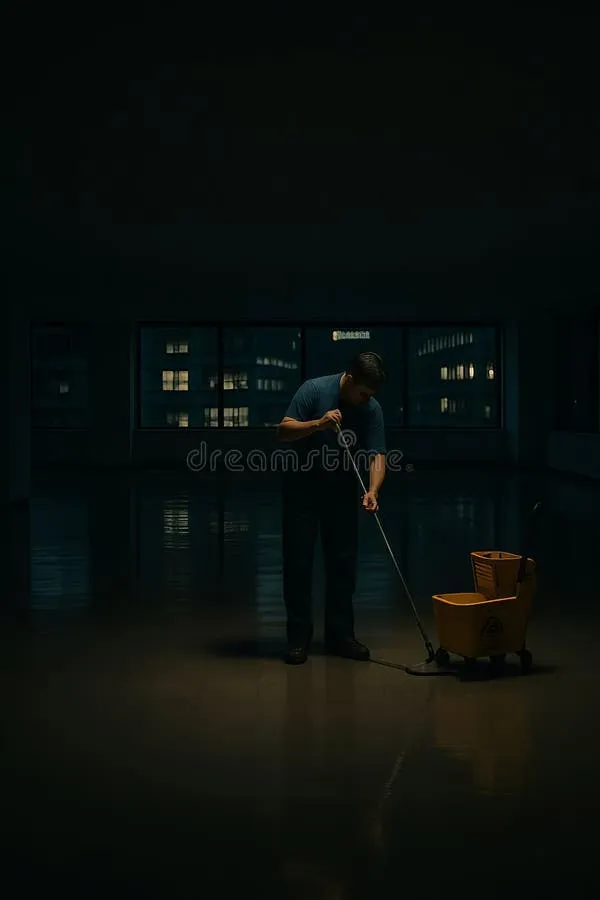
Photo: night shift janitor cleaning empty office hallway at night, via thumbs.dreamstime.com
The hallway smelled like industrial lemon polish at 2:40 in the morning, and that's when the man with the broom stopped walking.
He'd been staring at the same problem for six weeks by then — not a stain, not a scuff mark, but a mathematics problem he'd copied onto the back of a supply requisition form. It was the kind of problem that had eaten through defense contracts and think-tank salaries. And here it was, being chewed on by a night-shift custodian with a community college dropout's transcript and a library card he'd worn soft at the edges.
The Credential Gap Nobody Talks About
American institutions love to say they hire the best and brightest. What they usually mean is they hire the best-credentialed. And the difference between those two things is where a staggering amount of talent goes to die.
The story of self-taught cryptographers isn't folklore — it's practically a genre. William Friedman, the man who essentially built American codebreaking before World War II, got into cryptography through a bizarre side door: a wealthy textile magnate hired him to prove spiritualists were faking messages from the dead. He learned the field by trying to debunk a séance. No clearance. No degree in the field. Just obsession and a notebook.
The custodian in our story followed a more modern version of the same path. He'd washed out of college — money, not grades, though nobody checked which — and landed a maintenance job in a government building through a cousin. The job was fine. The building was the interesting part.
Learning on the Clock
His breaks became his classroom. Thirty minutes here, twenty minutes there, hunched over library books on number theory with a peanut butter sandwich. When the books ran out, he found lecture notes online. When the lecture notes hit their limit, he started working problems nobody had assigned him.
That's how he found it: an open technical challenge, published by a federal research group, about a vulnerability class in certain cryptographic systems. Government teams had thrown years at it. The challenge had outlived three program managers.
He didn't solve it in a flash of genius. He solved it the way night-shift people solve things — slowly, invisibly, in stolen increments. He filled legal pads. He filled the backs of work orders. At some point his supervisor started noticing the custodial closets looked like a math professor's office had exploded.
Sending the Letter
When he finally had something coherent, he faced the oldest problem in the outsider's playbook: nobody answers letters from people without titles.
He sent his work to the research group anyway. It sat. He sent it again with a cleaner write-up. It sat longer. Only when a junior analyst — someone young enough to still read everything — pulled it out of the pile did the reaction turn from silence to a phone call that reportedly lasted four hours.
The verification process was brutal, and it should have been. Extraordinary claims from unknown sources demand extraordinary scrutiny. But the math held. The approach was genuinely novel in a way the internal teams hadn't considered, largely because he hadn't been trained to consider the problem the way they did. His inexperience, the thing that kept his letters in the pile, was also the reason his solution looked different.
What the Broom Saw
Here's the uncomfortable part of this story, and it's the part that should make every hiring manager squirm: the custodian worked in the building. Not across the country from the problem — in the same building, mopping the same floors the researchers walked on their way to meetings about the problem.
Nobody asked him what he was reading. Nobody asked what was on those legal pads. The assumption ran one direction: a man in coveralls pushing a mop cart at 3 a.m. is not a person with a research agenda.
There's a name for this in the sociology of work — status-based invisibility. We literally stop perceiving people whose job titles signal 'background.' The custodian wasn't hiding his work. He was hidden.
The Fix Isn't Inspiration — It's Plumbing
Stories like this get told as inspiration: dream big, keep studying, your moment will come. Fine. But the more useful lesson is institutional. Open technical challenges exist precisely because organizations know talent lives outside their walls — yet the intake mechanisms for those challenges are often as welcoming as a locked door.
The groups that get this right do a few unglamorous things. They pay for anonymous submissions to be reviewed. They run bounty programs with real money attached, because money is the one credential everyone recognizes. They review by work product, not résumé, at least in a first pass.
The custodian in this story eventually got what he'd earned — a research role, proper credit, a career that matched his capability. But he's quick to note the arithmetic that haunts him: for every person whose letter gets pulled from the pile by one curious junior analyst, how many legal pads are filling up in custodial closets, in warehouses, on long-haul trucks, in break rooms from Ohio to Oregon?
Talent doesn't have a dress code. It doesn't have a degree. Sometimes it doesn't even have a desk. What it has is a problem it can't stop thinking about — and the only question that matters is whether anyone with power ever bothers to look up from their badge and ask what's on the paper.
The next Friedman might be emptying your trash tonight. It costs nothing to ask what they're reading.