He Couldn't See the Blueprint, So He Learned to Feel the Building: Tom Prentice's Second Life as an Architect
He Couldn't See the Blueprint, So He Learned to Feel the Building: Tom Prentice's Second Life as an Architect
There's a particular cruelty to losing the thing your profession depends on. A pianist going deaf. A painter losing their hands. An architect going blind.
 Photo: Tom Prentice, via thehighlander.ca
Tom Prentice went blind.
And then he kept working.
What happened next is one of the stranger and more quietly radical stories in modern design — a man who lost the sense his entire field worships, and in doing so, stumbled into a way of understanding buildings that most of his sighted colleagues had never even considered.
The World Architecture Builds For
If you've spent any time looking at architectural magazines, you already know the aesthetic. Glass and steel. Dramatic angles photographed at golden hour. Buildings that look extraordinary from the outside and occasionally forget that humans need to move through them, live in them, grow old in them.
Architecture, for most of its modern history, has been a deeply visual profession. You draw. You render. You present boards full of images. The photograph of the finished building is, in some ways, the whole point. Awards are given to things that look stunning in a single frame.
Tom Prentice built his early career inside that world. He was a practicing architect in Scotland, trained in the traditional mode, working through drawings and models and the visual grammar that defines the profession. Then his sight began to fail.
By the time it was gone entirely, he faced a choice that most people in his position would have resolved quickly: retire gracefully, consult in some limited capacity, step back.
He chose none of those things.
Building a New Language
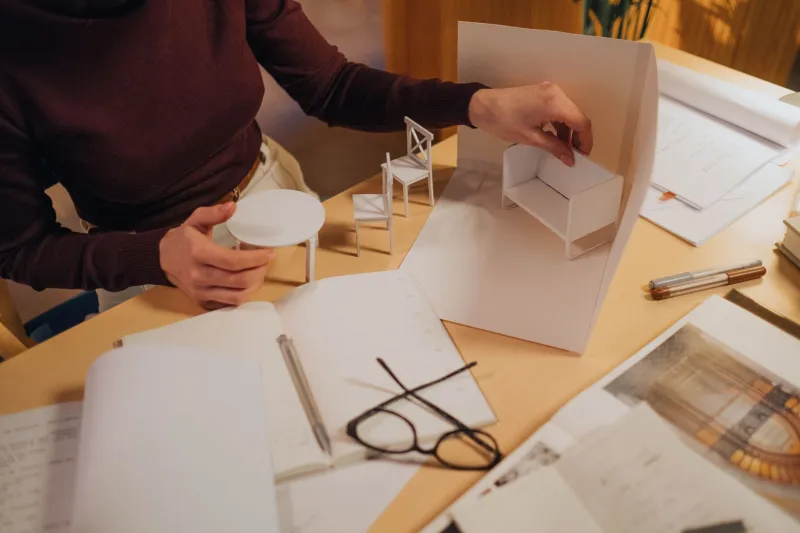
What Prentice did instead was methodical and, in retrospect, kind of astonishing. He began developing an entirely new set of tools for understanding and communicating space — tactile models he could run his hands across, physical mock-ups that conveyed proportion and flow through touch rather than sight, and a refined sensitivity to the acoustic and thermal qualities of a room that most architects register only dimly if at all.
He started paying attention to things his sighted peers routinely ignored. How does a space sound when it's empty versus occupied? Where does warmth pool in a room? How does the texture of a floor change the way you navigate it without looking down? What does a doorway feel like when it's sized for a wheelchair versus sized for a standard-issue adult body?
These weren't abstract questions for Prentice. They were his daily reality. And as he rebuilt his practice around them, something unexpected happened: the buildings got better.
Not just more accessible — though they were certainly that. Better in a fuller sense. More human. More attuned to the actual experience of being inside them rather than the experience of photographing them from across the street.
The Disability That Became a Design Philosophy
Prentice became a leading voice in accessible design in Scotland, contributing to projects and frameworks that pushed the country's built environment toward something more genuinely inclusive. His work influenced how architects thought about designing for people with disabilities — not as a compliance checkbox, not as a ramp bolted on at the end of the design process, but as a fundamental starting point.
This is the part of the story that deserves more attention than it usually gets.
Accessible design, when it's done well, doesn't just serve people with disabilities. It serves everyone. Curb cuts were designed for wheelchair users and turned out to be essential for parents with strollers, delivery workers with hand trucks, and elderly people who've lost some of their steadiness. Automatic doors were installed for people who couldn't operate handles and became the default expectation for every grocery store in America. When you design for the edges of human experience, you tend to improve the center.
Prentice understood this not as a theoretical proposition but as lived knowledge. He was designing from the edges himself.
What Sighted Architects Miss
There's a provocative argument embedded in Prentice's career, and it's worth sitting with: that the visual bias of modern architecture has produced buildings that are, in important ways, less successful than they could be.
When the primary measure of a building's quality is how it looks — in photos, in renderings, in the architectural press — the qualities that actually determine whether a space feels good to inhabit tend to get subordinated. Acoustics. Thermal comfort. Wayfinding. The intuitive sense of where you are and where you're going. The feeling of being welcomed versus surveilled.
These are things you experience with your whole body, not just your eyes. And they're the things Prentice was forced to prioritize because he had no other option.
In losing one mode of perception, he developed a heightened sensitivity to all the others. His spatial reasoning — the ability to hold a three-dimensional environment in his mind and reason about how it would function — became extraordinarily refined. Colleagues who worked with him described a man who could hold the entire logic of a building in his head with a clarity that put visual thinkers to shame.
The Crooked Path to Better Buildings
Prentice's story doesn't fit neatly into the standard inspirational template. He didn't overcome his disability to succeed despite it. He was transformed by it, professionally and creatively, in ways that made his later work more valuable than his earlier work — not because blindness is a gift, but because the constraints it imposed forced him to develop capacities that his training had never demanded.
That's a harder and more interesting lesson than the simple triumph narrative.
The profession he returned to after losing his sight was the same profession in name only. He had rebuilt it around different questions, different tools, different measures of success. And the buildings that came out of that rebuilt practice asked something of the people who occupied them — asked them to feel at home, to move freely, to be considered rather than impressed.
In a field that often mistakes spectacle for excellence, that's a genuinely radical position.
He never saw the buildings he designed in his second career. But by every account that matters — the people who moved through them, lived in them, found them navigable and welcoming and built for actual human bodies — he understood them more completely than most architects ever understand anything they build.
The path was crooked. The destination was somewhere most of his peers never thought to go.